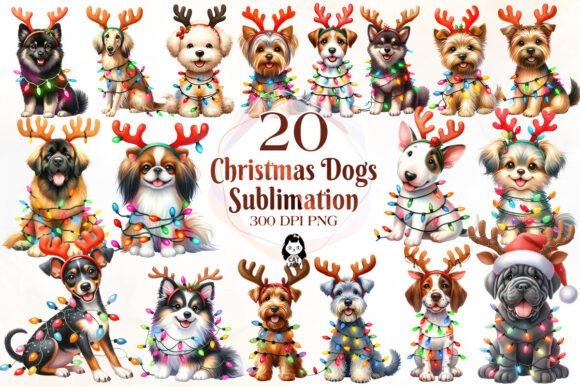
Reviewing Christmas Dog Sublimation Clipart Part 7 for Embroidery
As an embroidery designer who spends more time staring at digitized paths than I do sleeping, I have learned to look past the initial flash of a graphic. When I first opened Christmas Dog Sublimation Clipart Part 7, my immediate reaction was not just about the cuteness factor, though that is certainly present. Instead, I looked at the lines, the color blocks, and the negative space. This set falls under the category of Illustrations, which often presents unique challenges when translating from a flat digital image to a textured, stitched reality.
The mood this collection creates is undeniably warm and nostalgic. It captures that specific cozy feeling of the holiday season, featuring canine companions in various festive poses. For those of us running a craft business or managing an Etsy seller account, mood is half the battle. If the design does not evoke an emotional response, it rarely converts into a sale. However, emotion does not stitch itself. We need to determine if these illustrations can withstand the mechanical realities of a machine embroidery design.
From Screen to Stitch: A Real-World Test
To truly evaluate Christmas Dog Sublimation Clipart Part 7, I moved beyond the screen and into the studio. I imagined a specific scenario: a custom order for a local boutique needing holiday-themed tote bag design options. The client wanted something cheerful but not overly childish, suitable for adults carrying gifts or groceries.
I selected one of the dog illustrations from Part 7 that featured a golden retriever wearing a Santa hat. On screen, the gradient in the fur looked smooth. In embroidery, gradients are tricky. They require careful manipulation of thread colors and stitch density to avoid looking muddy or blocky. If you were to use this as a direct applique design, the result would be crisp and clean, leveraging fabric textures rather than thread fills. This is often the smarter route for sublimation-style graphics that rely on soft edges.
If you choose to stitch it out fully using fill stitch techniques, you must pay attention to the direction of the stitches. Fur texture requires varied angles to look natural. A flat, uniform fill will make the dog look like a stiff cartoon rather than a beloved pet. For a sweatshirt embroidery project, this distinction is vital. The plush fabric of a sweatshirt can hide minor imperfections, but it can also swallow up fine details if the stabilizer is not robust enough.
Navigating Fabric and Hoop Constraints
One of the most critical aspects of using any clipart-based resource for embroidery is understanding scale. Christmas Dog Sublimation Clipart Part 7 contains elements that may vary in complexity. When working with small hoop size constraints, such as a 4x4 inch hoop for a embroidered patch or a cap, you must simplify. Intricate details in the original illustration might need to be merged or removed entirely.
Consider the background. Sublimation designs often have transparent or white backgrounds. In embroidery, you are stitching onto fabric. If you place a light-colored dog on a dark navy custom apparel piece, you need to ensure there is enough contrast. Sometimes, this means adding a satin stitch border or an underlay to prevent the fabric color from bleeding through the running stitch outlines.
Textured fabrics pose another challenge. A terry cloth towel or a fluffy blanket will interact differently with the thread than a smooth cotton poplin. For a baby embroidery item, softness is key. High-density stitching can make a garment stiff and uncomfortable. Therefore, when using these design assets for infant wear, opt for lighter fill densities or stick to outline-only styles that preserve the drape of the fabric.
Commercial Viability and Customer Trust
For commercial embroidery professionals, the perceived value of the finished product is paramount. Customers can spot a low-effort design from a mile away. If the proportions of the dog are off, or if the festive elements look slapped on without integration, it diminishes the brand's professionalism. Christmas Dog Sublimation Clipart Part 7 offers a strong foundation, but it requires the designer's eye to refine it.
Using these illustrations for holiday embroidery collections can boost buyer engagement during the Q4 rush. However, consistency is key. If you are creating a line of personalized gift items, ensure that the style of the dog matches the font and other graphical elements. A mismatched aesthetic can confuse customers and lower trust.
Furthermore, consider the durability. Items like aprons and kitchen towel covers undergo frequent washing. Dense stitching holds up well, but loose threads or poor tension can unravel. Always test your digitized version on scrap fabric before committing to a client's garment. Check how the threads behave after a wash cycle. This step is non-negotiable for maintaining a reputation as a reliable small shop product creator.
Practical Notes for the Digitizer
Before you load Christmas Dog Sublimation Clipart Part 7 into your software, take a moment to plan. Here are a few practical steps to ensure success:
- Check the License: Always confirm whether the digital embroidery file or the source illustration allows for commercial use. Just because you bought the clipart does not always mean you can sell the stitched output without checking terms.
- Mockup in Black and White: Remove color from your preview. If the design loses its shape without color, it relies too heavily on shading rather than structure. Good embroidery relies on strong shapes.
- Test Stabilizer Combinations: Different fabrics require different support. A cut-away stabilizer might be best for stretchy knits, while a tear-away works for stable wovens.
- Inspect Small Details: Zoom in on the eyes and nose of the dog. These are focal points. Ensure they are digitized with precision, possibly using satin stitches for clarity rather than tiny fills.
- Compare Light and Dark Backgrounds: Create a printable mockup or a digital preview on both white and black backgrounds to see if your thread choices hold up.
In conclusion, Christmas Dog Sublimation Clipart Part 7 is a versatile resource for the creative entrepreneur. It bridges the gap between digital art and tactile craft. However, its success depends entirely on the skill and attention to detail of the designer. By respecting the limitations of the medium and prioritizing quality execution, you can transform these illustrations into cherished handmade product items that customers will love for years to come. Whether you are making a single personalized gift or a hundred units for a boutique, the effort you put into the digitization process will show in every stitch.